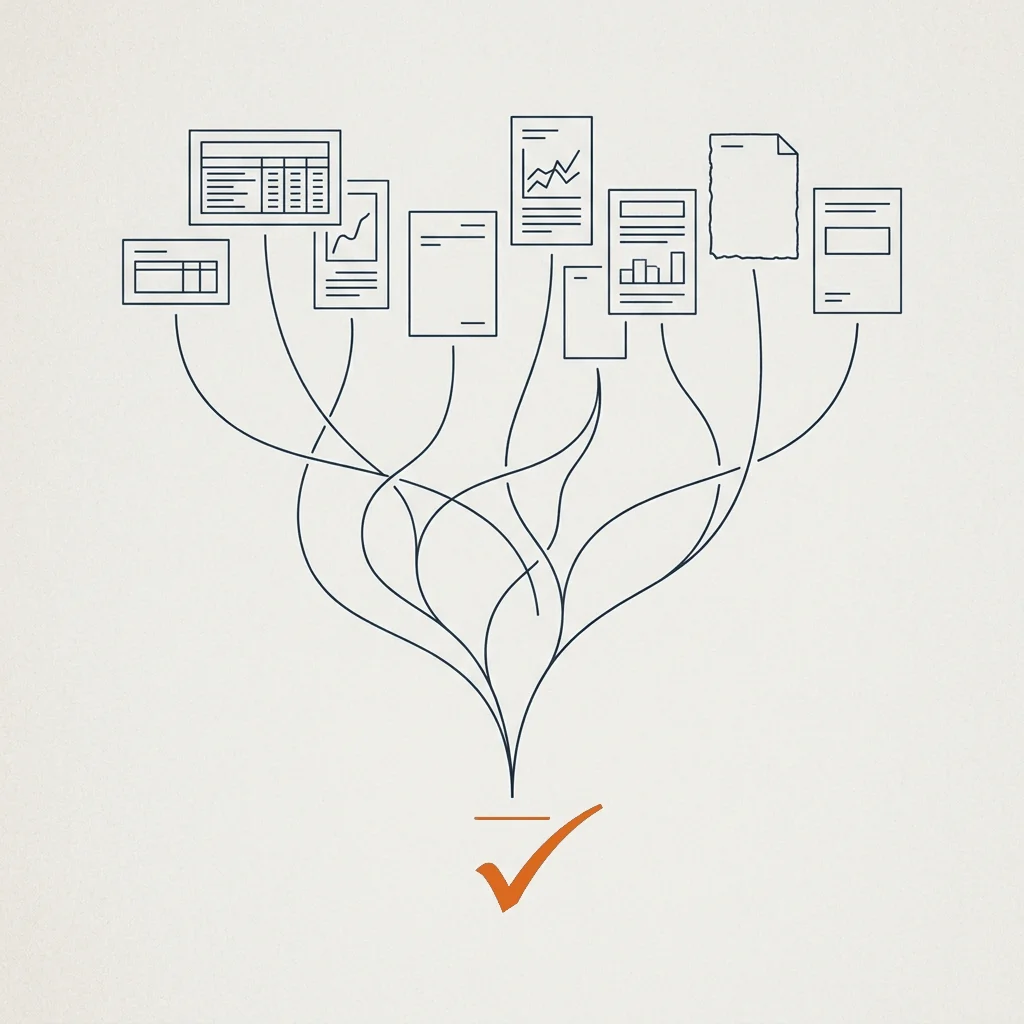
From many diverse sources to a single verified data point: traceability is the principle that holds up every figure we put in a report.
If we hand you a report and it doesn't hold up in a meeting, we both fail. That's why we work this way.
From many diverse sources to a single verified data point: traceability is the principle that holds up every figure we put in a report.
You won't find a loose data point in any of our reports. Next to every figure we put who published it, when, and how it was reached. So anyone on your team can verify it on the spot or defend the report in a committee.
When a data point drives the recommendation, we don't settle for the first source we find. We look for at least one independent source confirming it. If the two match, confidence is high. If they disagree, we show you both versions so you can decide which one to use.
The sources we use: official European and national records (over twenty official sources such as Eurostat, the World Bank, the Spanish Official Gazette, EUR-Lex, the Spanish judicial documentation centre), sector databases and international bodies. The hierarchy is always the same: official first, specialised second, generalist only as complement.
When a figure isn't verifiable (because the source isn't accessible, no public data exists, or sources contradict each other), we don't paper it over with a comfortable estimate. We flag it explicitly in the report. We'd rather hand you an incomplete but honest report than a complete one that won't survive a question.
Every data point you receive carries one of these four markers. At a glance you know what you can rely on and where to read with care.
You can rely on it to make the decision. The source is identified and accessible.
The source is good, but the figure is estimated or covers only part of the period or geography. Useful with caveats.
The data is mentioned somewhere but we couldn't confirm it. We flag it so you don't lean on it without verifying yourself.
Two or more different figures for the same data point. We show you both versions, their origin and our assessment of which one is more reliable.
So you know exactly what to expect before commissioning a report.
Ask us for a quick exploration of your sector and check on your own data what the above actually looks like in practice.
Request your analysis